Integrative Healthcare Solutions: Empower Your Wellness Journey
Empower your wellness journey with trusted experience in healthcare services, guided by a hybrid clinician specializing in integrative healthcare, physical therapy, and sports medicine.

Empower your wellness journey with trusted experience in healthcare services, guided by a hybrid clinician specializing in integrative healthcare, physical therapy, and sports medicine.
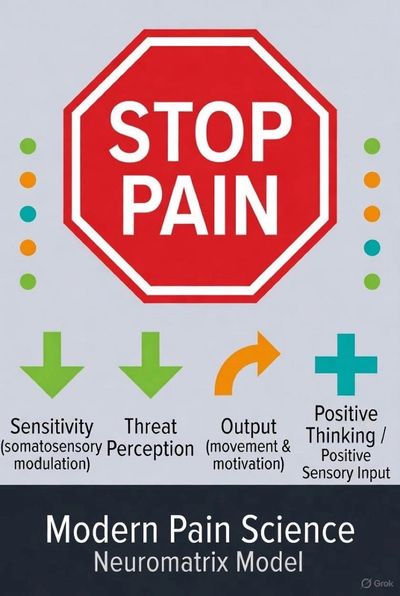
Summarizing a modern, biopsychosocial approach to chronic pain management, heavily influenced by the Neuromatrix Model of pain (Melzack) and contemporary pain science (Moseley, Butler, etc.).
Let me break down and explain what this diagram is actually teaching:
Core Message: “STOP PAIN”
The big red stop sign is a deliberate metaphor — it’s telling both patients and clinicians to stop doing what we used to do (treating pain purely as a structural/tissue-based alarm signal) and instead adopt a more nuanced, brain-centered understanding.
The Four Evidence-Based Strategies to Reduce Pain
1. ↓ Sensitivity (somatosensory modulation) Green downward arrow = reduce the volume of nociceptive input and central sensitization Practical examples:
• Graded exposure / paced activity
• Sleep hygiene, stress reduction
• Desensitization techniques (e.g., graded motor imagery, tactile discrimination)
• Sometimes medications that calm hyperexcitable neurons (but not as the only strategy)
2. ↓ Threat Perception The single biggest lever in chronic pain according to current science Pain = perceived need to protect the body. Lower the perceived danger → lower the pain Methods:
• Pain neuroscience education (PNE)
• Cognitive restructuring (CBT elements)
• Mindfulness and acceptance-based approaches
• Addressing fear-avoidance and catastrophizing
3. ↷ Output (movement & motivation) Orange curved arrow = break the vicious cycle by changing protective behaviors Even if it still hurts a bit, healthy movement and engagement in valued activities recalibrates the neuromatrix Includes:
• Graded exposure to feared movements
• Behavioral activation
• Re-engaging in meaningful life roles
4. + Positive Thinking / Positive Sensory Input Green plus sign = actively add protective/pleasurable inputs to the system The brain constructs pain from ALL available inputs, so flood it with safety signals:
• Exercise you enjoy
• Social connection
• Nature, music, laughter
• Positive context and expectations (placebo/nocebo matters)
Bottom Banner: Modern Pain Science + Neuromatrix Model
This is the foundational framework:
Pain is not an accurate meter of tissue state.
It is a conscious output produced by the brain when it concludes (based on a weighted combination of all credible evidence) that the body is in danger and needs protecting.
Overall Takeaway
The old biomedical model said: “Find the painful structure → fix it → pain goes away.”
This diagram (correctly) says: “That approach fails most chronic pain patients. Instead, target the brain’s threat appraisal system from multiple angles simultaneously.”
It’s a concise, visually effective summary of what leading pain researchers (Lorimer Moseley, David Butler, Peter O’Sullivan, etc.) have been teaching for the last 15–20 years.
If you’re a clinician, this is the model you want to have in your waiting room.
If you’re a patient, this is the model that explains why “but my MRI is normal” doesn’t mean your pain is imaginary — and more importantly, it gives you multiple actionable levers to actually reduce it.
I developed this infographic about 15 years ago as part of a teaching and used as a patient education tool to adolescent patients to help understand pain science. Definitely it can be applied to adults.